
Why do some repairs accelerate corrosion? When a reinforced concrete structure is partially repaired without the appropriate precautions, corrosion can restart immediately adjacent to the repaired areas. This well-known phenomenon, referred to as the incipient anode effect or halo effect, represents a major threat to the long-term durability of infrastructure.
When conventional repair methods are not sufficient, cathodic protection, governed by the EN ISO 12696 standard, provides an effective barrier against corrosion and ensures long-lasting protection of structures. At BlueSpine, we design and manufacture cathodic protection solutions tailored to each project, ranging from galvanic cathodic protection (GCP) to impressed current cathodic protection (ICCP).
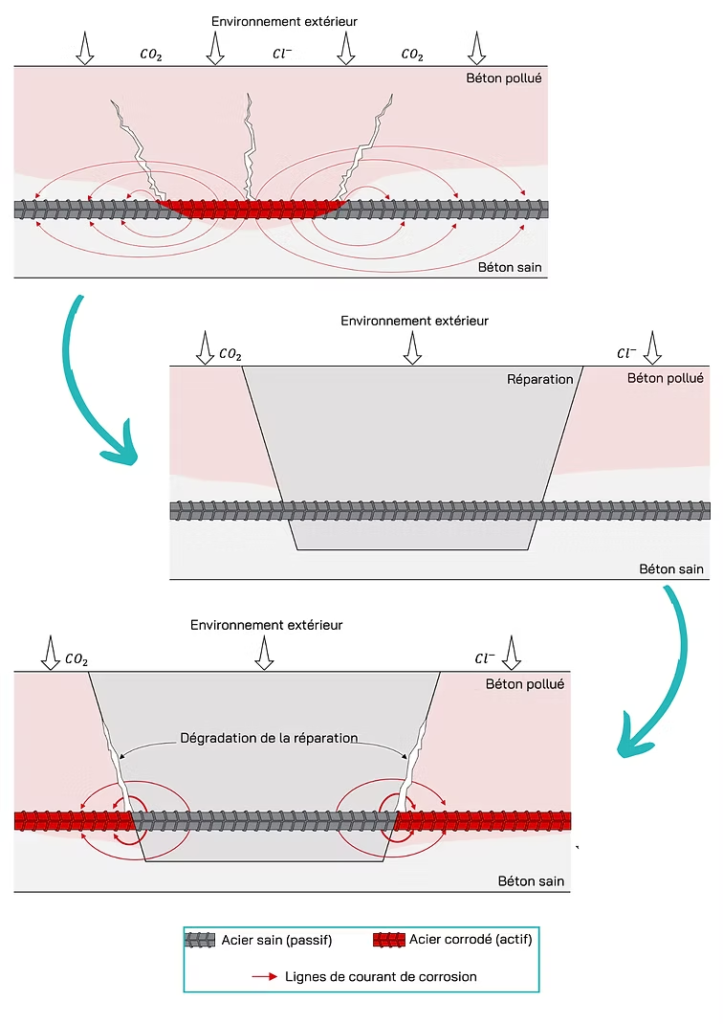
⚠️Induced anode (Halo effect): an insidious shift in corrosion
Repairing a corroded area without protecting the entire structure creates a galvanic cell that accelerates the deterioration of the adjacent steel.
During a conventional repair:
1️⃣ The damaged concrete is removed and replaced, restoring an alkaline environment around the local reinforcement.
2️⃣ The adjacent reinforcement remains embedded in deteriorated concrete containing chlorides or affected by carbonation.
3️⃣ An electrochemical potential difference develops between the repaired and unrepaired areas.
4️⃣ The result? Corrosion migrates to the reinforcement still exposed to aggressive conditions, accelerating its deterioration.
A few years after the repair (typically between 5 and 10 years), new cracks often appear around the repaired areas. The more effective the repair is locally, the more pronounced the incipient anode effect becomes, accelerating deterioration in the surrounding concrete.
🎯 How can induced anode formation be stopped?
The most effective and durable solution is the implementation of a cathodic protection system in accordance with the EN ISO 12696 standard. Unlike non-monitored galvanic anodes, this approach maintains a global electrochemical balance throughout the structure and provides reliable long-term protection against corrosion.
🔎 Corrosion protection solutions
🟡 BSP10+: a first line of defence against induced anodisation
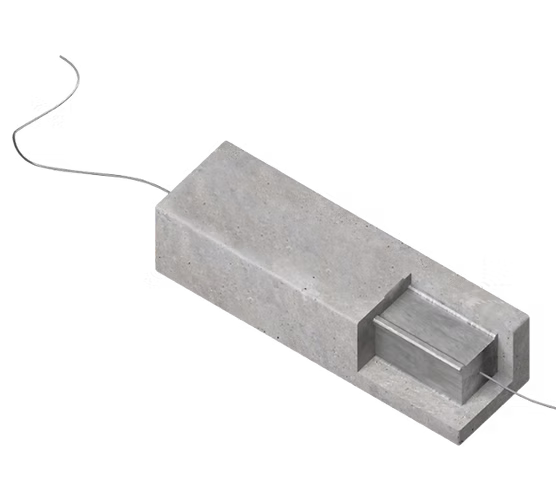
If the installation of a cathodic protection system is not immediately feasible, BSP10+ sacrificial zinc anodes provide an effective first line of defense. They help temporarily mitigate the halo effect while awaiting a more permanent solution. Their benefits include:
✅ Reducing the risk of corrosion in adjacent areas by partially neutralizing the incipient anode effect.
✅ Providing simple protection without an external power source, operating through the natural galvanic effect.
✅ Temporarily extending the service life of repairs while awaiting a more comprehensive solution.
However, this approach remains a temporary measure and is less effective than cathodic protection systems designed and implemented in accordance with the relevant standards.
🟢 Which cathodic protection system should you choose for your structure?
To ensure effective corrosion protection over several decades, it is essential to implement a cathodic protection system designed in accordance with international standards, including EN ISO 12696 and NACE SP0290.
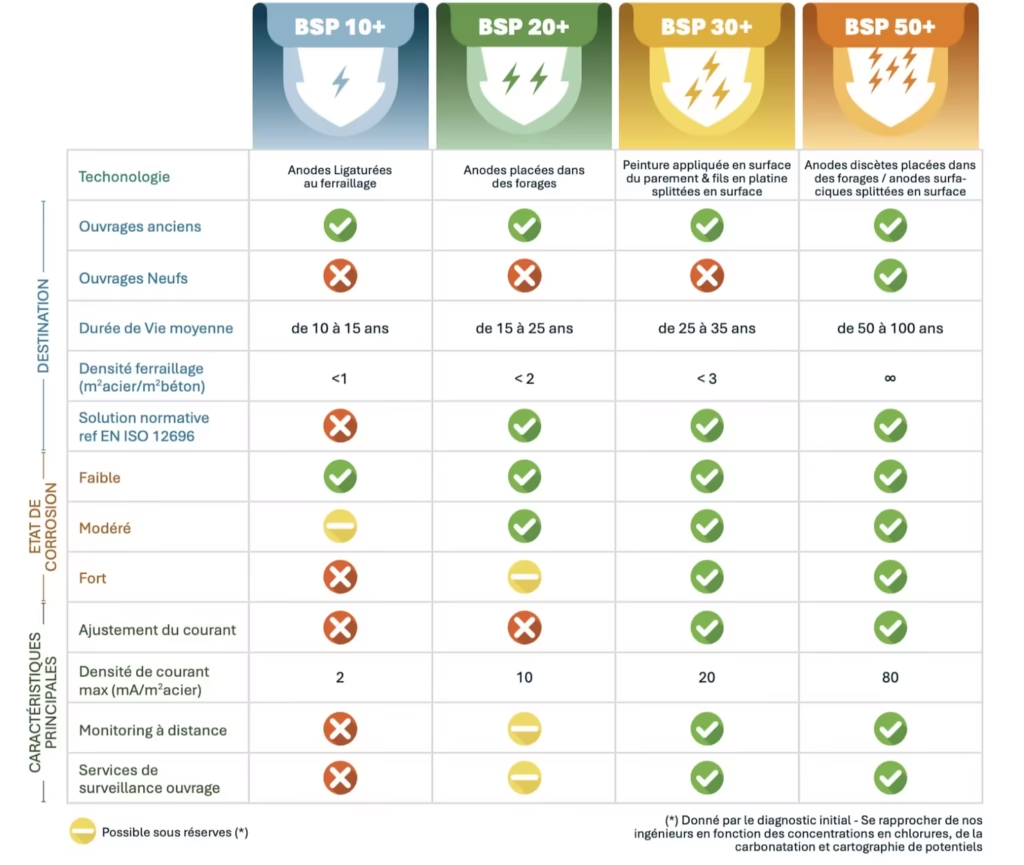
BSP20+, BSP30+, and BSP50+ solutions deliver the following benefits:
✅ Stop active corrosion and prevent any further migration of corrosion.
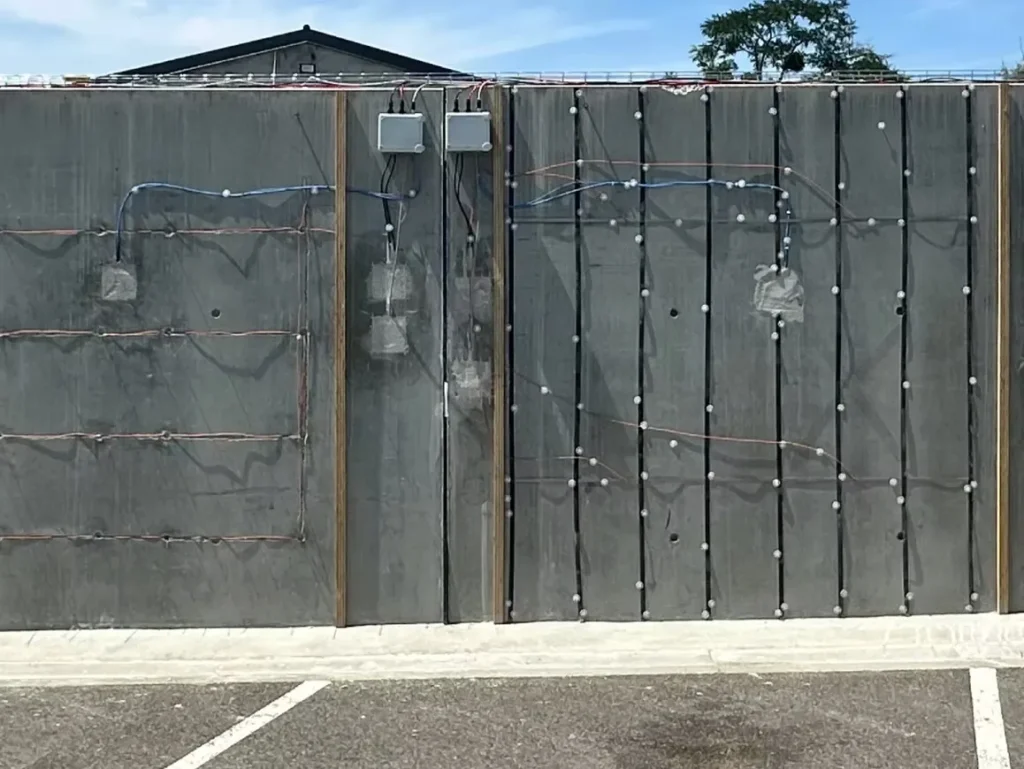
✅ Enable accurate performance monitoring through integrated monitoring systems.
✅ Extend the service life of structures, significantly reducing long-term maintenance costs.
🚀 Protect your infrastructure with BlueSpine!
Don’t let your repairs accelerate corrosion! Discover the BlueSpine range and adopt an effective cathodic protection solution:
- BSP10+ for immediate protection and simple implementation.
- BSP20+, BSP30+, and BSP50+ for long-lasting, standards-compliant protection against corrosion.
📩 Contact our experts today and ensure long-term protection for your infrastructure with a tailored solution!